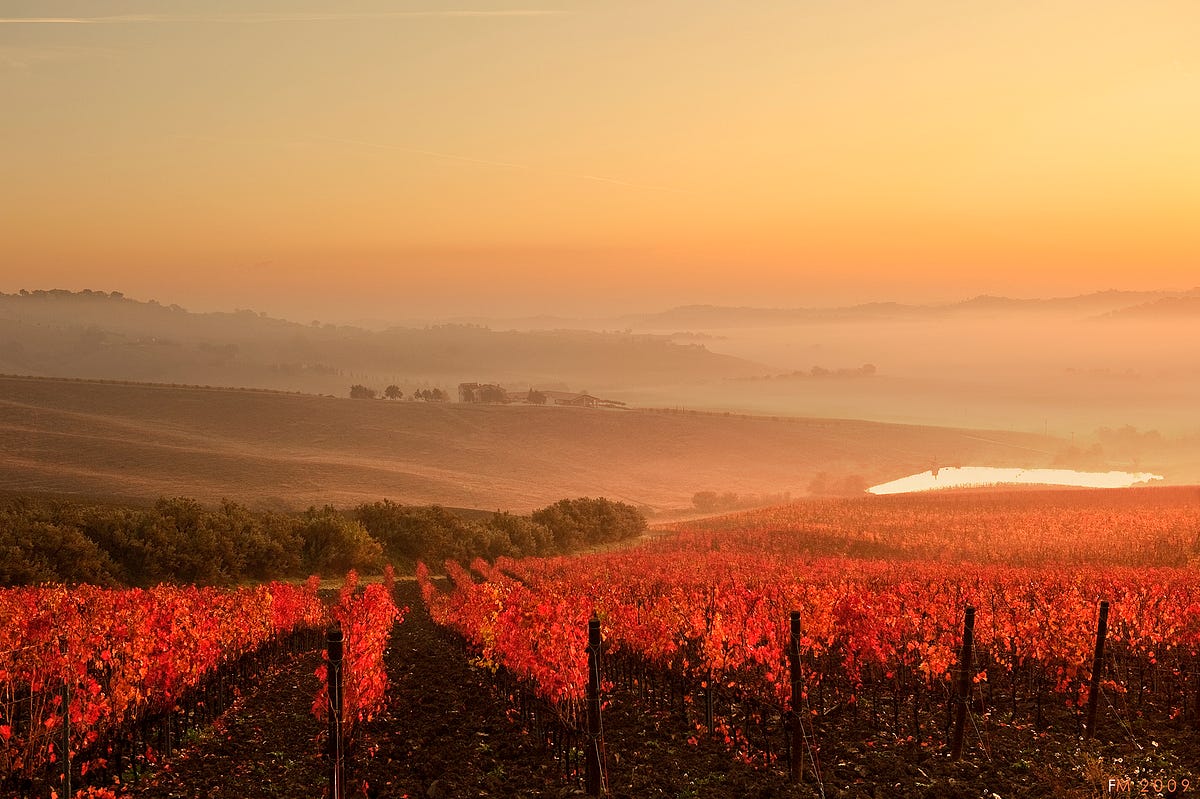
Autumn, with its vibrant colors, is the best season to explore the landscapes of the Terre del Lacrima, home to Morro d’Alba’s native grape variety. Morro d’Alba is recognized as a City of Wine and is one of Italy’s “Most Beautiful Villages.” This extraordinary area produces a ruby-red nectar, Lacrima di Morro d’Alba DOC, which attracts wine lovers and tourists just like the excellent white Castelli di Jesi Verdicchio Classico. The strong rural character of the region is especially visible from the ridge of the Sant’Amico district, accessible from Morro d’Alba via a scenic road: a peaceful, hardworking world of oaks, sunflowers, olive trees, vineyards, wineries, and hospitality venues that create a countryside etched in memory.
The rolling hills, halfway between the Adriatic seaside town of Senigallia and the city of Jesi, birthplace of Frederick II, have been inhabited since ancient times. In Sant’Amico, a 6th-century Byzantine gold medallion depicting Theodoric the Great—the only known image of the Ostrogoth king, featuring Gothic-style moustaches—was discovered.
Morro derives its name from the hill (Murr in the pre-Roman language) where the fortress was strategically built to oversee the territory. By 1213, it came under Jesi’s influence. The original pentagonal city walls and the unique patrol walkway, known as La Scarpa, characterize this small village of 1,800 inhabitants. The fortress is a rare European structure: Castrum Murri, the original feudal fortification, now features imposing sloped walls and tall polygonal towers. From the 17th century onward, the fortress lost its defensive role. With internal space limited, new houses were built atop the walls in the following century, covering parts of the original walkway.
Thus was born La Scarpa, a nearly 300-meter-long, mostly covered path along the perimeter of the castle walls. Regularly spaced openings, known as finestroni, allow views of the surrounding countryside. This architectural expansion created a kind of self-contained micro-city, where the doors of main houses and even the municipal building faced the walkway, making it the village’s main street. Later, the openings along the walkway became artisan shops.
Walking along La Scarpa provides a spectacular vantage point over the Marche countryside, stretching from the Sibillini Mountains to the Adriatic Sea, the Conero Massif, and the San Bartolo promontory near Pesaro. Seen through the nearly ninety windows along the walkway, the landscape appears like a painting, ever-changing. Hills roll gently from mountains to sea, forming elegant lines reminiscent of Mario Giacomelli’s famous photographs displayed in the castle’s underground Utensilia Museum.
Depending on the time of day and season, La Scarpa offers unique experiences. The countryside constantly changes in light and color, and along one of the short open stretches, visitors can take in both mountains and sea at a single glance. Two uncovered towers allow stepping outside the walls for a different view: the Frederick I (Barbarossa) tower to the west, perfect for romantic sunsets among swirling swallows, and the Teodorico tower to the east, ideal for summer sunrises reflecting on the sea just ten kilometers away. Guitar concerts, poetry readings, and candlelit wine tastings—especially at sunset when the interplay of light and color enhances the walkway—transform this exceptional monument, recognized as an Italian Wonder, into a stage for events for residents and tourists. On weekends, music flows through the walkway via a diffusion system, making it so enchanting that many couples choose it for civil weddings. A nighttime visit reveals even more, with light design installations adding to the magic.
The castle’s underground spaces further enrich Morro d’Alba’s unique architecture. These hypogeal areas, dating from the 14th–15th centuries, consist of a complex network of caves, tunnels, corridors, wells, and niches. Accessible from the walkway, they now house the Utensilia Museum, a collection of objects, agricultural tools, and domestic items reflecting the sharecropping culture that shaped this highly fragmented territory, where each farmhouse was a self-contained microcosm.
Inside the castle walls, the 18th-century municipal building on the inner square houses a canvas by Claudio Ridolfi (c. 1630), while the 18th-century San Gaudenzio Church, recently restored, shines with natural light thanks to the recovery of its original pink and white stone flooring and the rediscovery of gilded pilasters decorating the transept and columns.
Autumn foliage is when the countryside surrounding the castle and village most vividly renews its bond. Wine production, mainly Lacrima DOC but also Castelli di Jesi Verdicchio Classico, has long shaped the region. In summer, the hills seen from the walkway are dominated by green vineyards and yellow sunflowers. After the seaside season, the countryside dons its “red skirt,” as Emily Dickinson might say. Lacrima grape leaves first take on scarlet shades, then deepen into an intense red, mirroring the wine itself. Verdicchio leaves turn golden under the sun, reminiscent of summer light. From the walkway to the vineyards, it’s a short stroll: the castle walls give way to well-kept countryside paths leading to Sant’Amico. Photographers can wander among the rows, enjoying enchanting views, lush untamed vegetation, and the scent of ripening grapes, occasionally tasting a few along the way. A stop at the rural church of Saints Simon and Jude, built in the 16th century using bricks likely sourced from nearby Roman ruins, enriches the walk. Returning at sunset evokes Van Gogh’s Red Vineyard, a sensory experience culminating in a tasting of Lacrima DOC at one of the village’s wineries.
October is not just harvest season; it also celebrates truffles. During the third weekend of the month, the Marche’s two local treasures—the Lacrima di Morro d’Alba and Acqualagna truffles—are honored together in a three-day festival, with the whole community participating. In addition to guided tours of the village and wineries, visitors can enjoy concerts, art exhibitions (including the stele in Piazza Tarsetti by Enzo Cucchi and the permanent display in the council chamber), and local culinary specialties such as rabbit and rooster in potacchio sauce, vincisgrassi, and countryside-style tagliatelle.
Text by Alessandra Boldreghini